Air Freight Forwarding connects manufacturers, online retailers, and customers through carefully coordinated air transport. A forwarder compares routes, space, schedules, handling needs, and documentation. The process usually begins with cargo collection and shipment planning. It continues through consolidation, airport handling, customs coordination, flight movement, and final delivery. Timing matters. A small delay at a warehouse can affect an entire connection.
Industry data shows why this service matters. IATA’s Air Cargo Market Analysis reported an 11.3% increase in global air-cargo demand during 2024, measured in cargo tonne-kilometers. Available capacity also grew, but more slowly, by 7.4%. This imbalance can make space expensive during peak periods. The WorldACD Market Data report similarly tracks changing volumes, yields, and trade lanes across major markets. These reports offer useful evidence, although no single dataset explains every shipment.
Brendan Sullivan, IATA’s Global Head of Cargo, has described air cargo as “a critical component of the global economy.” His observation reflects the forwarder’s wider role. Air Freight Forwarding is not simply booking an aircraft. It requires practical judgment, reliable communication, and accurate shipment visibility. Temperature-sensitive products need controlled handling. High-value machinery needs secure transfer points. Unexpected weather still creates pressure. That reality deserves more attention. Forwarders can reduce risk, but they cannot remove every uncertainty. A strong introduction should therefore examine the people, systems, costs, and decisions behind each movement, rather than presenting air transport as effortless.
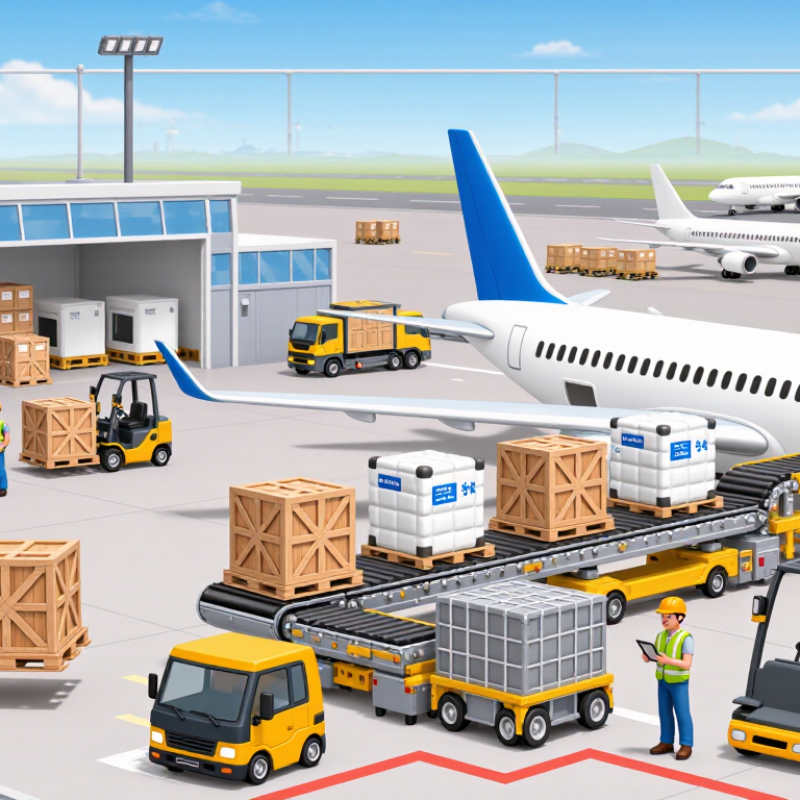
Air Freight Forwarding Defined: A Managed Route for Time-Critical Cargo
Air freight forwarding is a managed route for time-critical cargo. It connects the shipper, carrier, airport, customs authority, and final receiver. A forwarder does not simply buy space on an aircraft. It plans the movement, checks shipment details, prepares transport documents, and coordinates each handoff. This work matters when a production line needs a replacement part or medical equipment must arrive within a narrow window. Time has a cost.
The process usually begins with cargo measurements, weight, origin, destination, and delivery deadline. The forwarding team selects a suitable airport pair and flight plan. It arranges pickup, security screening, export clearance, and warehouse handling. At the destination, it coordinates import clearance and final delivery. Shipment updates show where the cargo is, although tracking is not always immediate. A delayed scan can create unnecessary concern.
Reliable forwarding depends on accurate data and careful communication. Incorrect dimensions can change the price or leave cargo behind. Missing documents can hold a shipment at the border. Experienced teams review invoices, packing details, routing limits, and handling needs before tendering cargo. They also prepare alternatives when flights change or weather disrupts an airport. No plan is flawless. A practical review after delivery can reveal weak handoffs, unclear updates, or unrealistic deadlines, improving the next managed route.
The Main Participants: Shipper, Forwarder, Airline, Handler, and Customs
What Is Air Freight Forwarding and How Does It Work?
Air freight forwarding coordinates the movement of cargo from a shipper to its destination by air. The shipper prepares the goods, commercial documents, packing details, and delivery instructions. Accurate information matters. One incorrect weight can affect space, pricing, and customs review.
The forwarder connects the shipper with the airline and manages the shipment plan. They compare routing options, book air cargo space, check documents, and monitor handoffs. The airline provides the aircraft capacity and transports the shipment between airports. However, the airline usually does not manage every warehouse task. That work belongs to the handler, who receives, weighs, scans, stores, and loads cargo. Small labeling errors can still cause delays.
Customs reviews the shipment before export or import clearance. Officers may examine declared values, product descriptions, origin details, and supporting documents. The forwarder often submits information, but the shipper remains responsible for its accuracy. In practice, communication is rarely perfect. A late document from the shipper can interrupt an otherwise reliable schedule. A handler may also report a damaged carton after acceptance, requiring careful inspection and new records. Experienced teams reduce these problems through checklists, shipment tracking, and direct confirmation at each handoff. Yet no process removes every risk. Weather, airport congestion, and capacity changes can still alter the plan.
Booking and Preparation: Rates, AWB Data, Security, and ULD Loading
Air freight forwarding begins with a booking built on accurate cargo data. The forwarder checks origin, destination, ready date, commodity description, piece count, dimensions, and gross weight. Airlines calculate chargeable weight using actual or volumetric weight, whichever is higher. A small dimension error can change the rate sharply. Rates also reflect fuel costs, seasonality, capacity, handling fees, and screening requirements. According to IATA’s 2024 Air Cargo Market Analysis, global air cargo demand increased 11.3% year on year, while capacity rose 7.4%. Tight capacity can therefore make an early booking valuable.
The air waybill, or AWB, turns booking information into transport instructions. Its data should match the commercial invoice, packing list, labels, and physical cargo. Key fields include shipper and consignee details, airport codes, packages, weight, dimensions, and handling information. Missing data creates delays. Worse, incorrect data can trigger remeasurement or rebooking. IATA’s Cargo Services Conference materials consistently emphasize standardized electronic data for safer, faster processing. Electronic records help, but they do not correct careless entries.
Security preparation follows. Cargo is screened under applicable aviation security procedures before loading. The forwarder must confirm that packaging is closed, labels are readable, and the shipment can withstand handling. At the warehouse, pieces are consolidated into a unit load device, or ULD. Weight distribution matters. Heavy pieces belong low and close to the ULD center, while empty spaces need restraint. A neat build can still hide weak securing. This is where experienced warehouse checks matter most. Mistakes often begin before the cargo reaches the aircraft.
Air Freight Forwarding: Chargeable Weight in Booking and Preparation
Chargeable weight is generally the higher of gross weight and volumetric weight.
The examples below use the common air-freight formula: length × width × height in cm ÷ 6,000.
During booking, the forwarder collects accurate AWB data, including shipper and consignee details,
airport codes, package count, dimensions, gross weight, commodity description, and handling instructions.
Cargo must also pass the required security screening before acceptance and aircraft loading.
After approval, cartons or pallets are consolidated into compatible ULDs, while weight, balance,
loading limits, and special-cargo restrictions are checked. Actual chargeable-weight rules may vary by route and tariff.
Flight to Final Delivery: Screening, Customs, Tracking, and Proof of Delivery
Air freight forwarding connects a shipment with the right flight, documents, and delivery plan. The process begins when a forwarder checks the cargo details, dimensions, weight, and destination. Proper screening follows. Security staff inspect the shipment and compare it with the declared information. Missing or unclear details can cause delays before the aircraft even departs.
After departure, tracking records key movements, including arrival, unloading, and handover. Customs then reviews the commercial invoice, packing list, and applicable duties. A professional forwarder checks these documents carefully, but no system is perfect. A classification mistake can still lead to questions or storage charges. Clear communication with the importer helps resolve issues faster. Once customs releases the shipment, local transport carries it to the final address. The receiver signs a proof of delivery, which confirms the delivery time, recipient, and shipment condition.
Tips: Use accurate cargo descriptions and consistent quantities. Keep contact details current. Ask for milestone updates, not vague promises. Photograph the package before handover when condition matters. Tracking can pause during customs review; that does not always mean the shipment is lost. In practice, delivery estimates are useful, but they are not guarantees. Planning a small time buffer is wiser than relying on perfect timing.
IATA Data: Air Cargo Moves 35% of Global Trade Value, Under 1% by Volume
What Is Air Freight Forwarding and How Does It Work?
Air freight forwarding arranges the movement of cargo between the shipper and its destination. It connects shippers with airlines, airports, customs brokers, and ground carriers. The forwarder plans the route, prepares shipping documents, and coordinates warehouse handling. A shipment may begin with pickup at a factory, then move through airport screening and export processing. Small details matter.
IATA data shows air cargo moves about 35% of global trade value, while representing under 1% by volume. That contrast explains air freight’s economic importance. A compact shipment can contain valuable electronics, medical equipment, or urgent industrial parts. These goods may occupy little space but support major commercial activity. Yet the percentage needs context. It is an industry-wide estimate, not a promise for every product or route. Comparing value and volume can also hide large differences between markets.
After receiving shipment details, a forwarder checks dimensions, weight, timing, and destination requirements. Experienced teams verify labels, invoices, packing details, and handling instructions before booking space. Tracking events help customers identify delays or missed connections. Costs depend on chargeable weight, fuel conditions, airport fees, and service speed. Speed is not everything. A rushed booking can create avoidable costs when dimensions are inaccurate. Forwarders also monitor weather, capacity changes, and transfer schedules. That is where practical experience helps. Still, no process is perfect. Air cargo planning requires careful review, clear communication, and honest expectations.
What Is Air Freight Forwarding and How Does It Work? - IATA Data: Air Cargo Moves 35% of Global Trade Value, Under 1% by Volume
| Dimension |
Data or Standard Practice |
How It Works in Air Freight Forwarding |
| Share of global trade value |
Approximately 35% |
Air cargo is commonly selected for high-value, time-sensitive, or failure-critical goods because transport time is short compared with most ocean and surface alternatives. |
| Share of global trade volume |
Less than 1% by physical volume |
Air freight carries a relatively small quantity of worldwide cargo, but that cargo often has a comparatively high value per kilogram. |
| Main forwarding role |
Coordination of the shipment from origin to destination |
The forwarder arranges transport capacity, prepares or checks documents, coordinates customs information, consolidates cargo when appropriate, and tracks handoffs. |
| Typical shipment flow |
Booking → pickup → export handling → airport departure → airport arrival → import clearance → final delivery |
Each stage creates a handoff at which cargo status, security, documentation, and package condition may be checked. |
| Primary transport document |
Air Waybill (AWB) |
The AWB records shipment details such as the shipper, consignee, origin, destination, package count, weight, and applicable transport terms. It is not a document of title. |
| Export and import information |
Commercial invoice, packing list, customs data, and permits when required |
Accurate product descriptions, tariff classification, customs value, origin, and regulatory information help reduce clearance delays. |
| Chargeable weight |
The greater of actual gross weight and volumetric weight |
A commonly used air-cargo convention is: volumetric weight (kg) = length × width × height (cm) ÷ 6,000. The applicable carrier or route rule should always be confirmed. |
| Transit-time profile |
Often measured in hours or a few days for airport-to-airport movement |
Actual door-to-door time also depends on pickup scheduling, flight connections, security screening, customs clearance, weekends, and final-mile delivery. |
| Consolidation |
Multiple shipments may be combined into one larger air-cargo movement |
Consolidation can improve space utilization and pricing, while deconsolidation at destination adds a handling step before final delivery. |
| Security screening |
Required before cargo is accepted for carriage under applicable aviation-security rules |
Screening methods and acceptance requirements vary by jurisdiction, shipment type, and the cargo’s security status. |
| Special cargo controls |
Additional rules may apply to dangerous goods, batteries, live animals, perishables, medicines, and temperature-sensitive products |
The forwarder verifies packaging, labels, declarations, handling instructions, and any required approvals before booking. |
| Cost drivers |
Chargeable weight, route, capacity, fuel, security, handling, customs, and delivery requirements |
A quote should identify whether charges are based on actual or volumetric weight and whether origin, destination, and customs fees are included. |
| Best-fit cargo profile |
High-value, urgent, lightweight, compact, or time-critical shipments |
Common examples include urgent parts, electronics, pharmaceuticals, seasonal products, samples, and perishable goods, subject to applicable regulations. |
Note: The global trade shares above follow the industry statistic stated in the supplied title. Transit times, chargeable-weight rules, documentation, and acceptance requirements can vary by route, shipment type, and applicable regulation.
FAQS
It coordinates cargo movement from the shipper to the final destination by air. A forwarder plans routes, books space, checks documents, and monitors handoffs.
The shipper provides the goods, packing details, commercial documents, and delivery instructions. One wrong weight can change pricing, available space, or customs review.
The forwarder connects the shipper, airline, handler, customs, and local delivery provider. They also compare routes and track important shipment milestones.
The airline provides aircraft capacity and transports cargo between airports. It usually does not manage every warehouse activity.
The handler receives, weighs, scans, stores, and loads cargo. A small label error can delay acceptance. It happens.
Customs may review the commercial invoice, packing list, product description, origin, and declared value. Clear descriptions and consistent quantities reduce questions.
Tracking may pause during customs review, unloading, inspection, or handover. A pause does not always mean the shipment is lost. Still, confirmation is wise.
The handler may report the damage after acceptance. Teams should inspect the carton, create updated records, and photograph its condition. The process helps, but it cannot erase the damage.
The receiver signs proof of delivery after local transport reaches the final address. This record shows the delivery time, recipient, and shipment condition.
No. Weather, airport congestion, customs questions, and capacity changes can alter schedules. A small time buffer is safer than perfect timing. Plans can fail.
Conclusion
Air Freight Forwarding is a managed transportation process designed for time-critical and high-value cargo. It connects the shipper with a freight forwarder, airline, cargo handler, and customs authorities, allowing each party to coordinate the shipment from origin to destination. The forwarder typically compares rates, confirms space, organizes pickup, prepares air waybill data, and ensures that packaging and shipment details meet security and handling requirements.
After booking, cargo is screened, consolidated when appropriate, and loaded into suitable unit load devices for flight. During transit, tracking information helps monitor progress, while customs clearance verifies the shipment before release. Once the cargo arrives, local delivery is arranged and proof of delivery confirms completion. Air freight is especially important because it carries a significant share of global trade value despite representing less than one percent of worldwide trade volume by weight. This makes speed, accuracy, visibility, and careful documentation essential throughout the entire forwarding process.